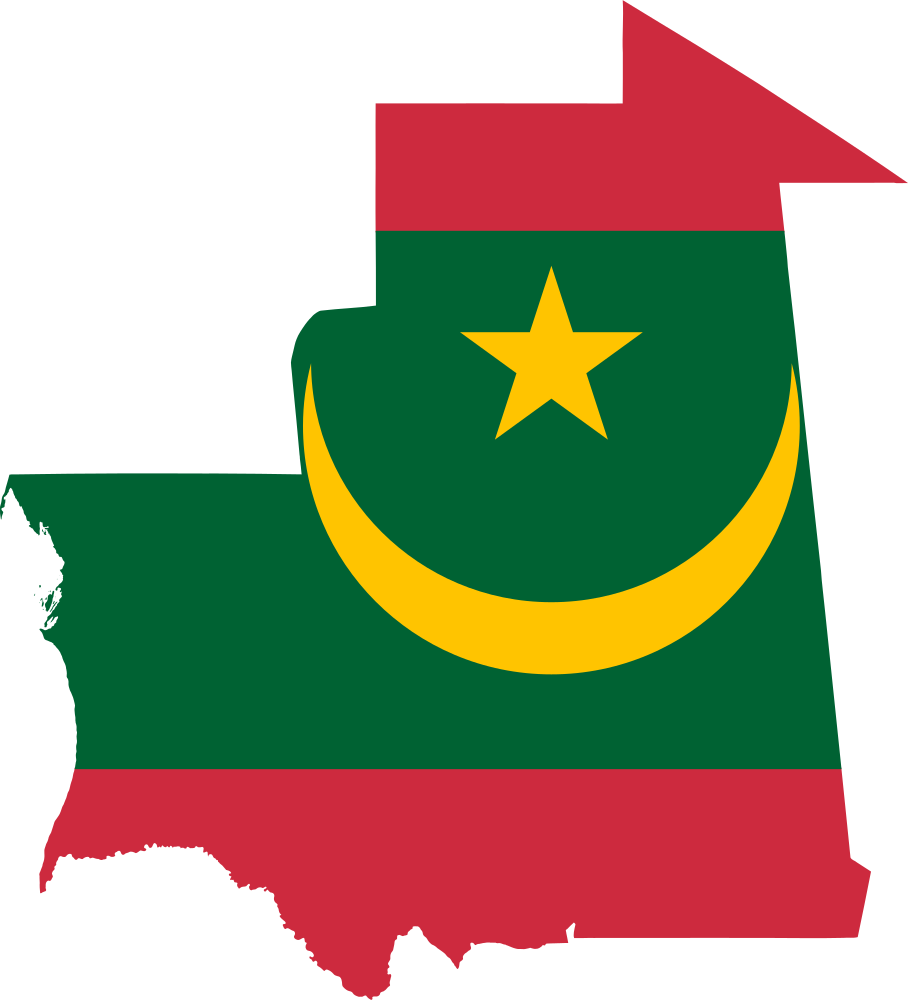
While international attention remains fixed on a handful of major crisis zones, one of the Sahel’s most entrenched human rights crises continues to go largely unnoticed: the systematic discrimination faced by religious minorities, the LGBTQ+ community, and disadvantaged groups within Mauritania’s tribal and caste system. The reasons behind this neglect are structural, geopolitical and, in part, deliberate.
Religious Belief Without Legal Protection
Mauritania is a highly centralized Islamic Republic with no legal provisions for freedom of religion. This means that dissenting beliefs, non-belief, or an open break from Islam are not merely socially condemned; they carry legal consequences. For non-believers and dissenters, there is no protected space; their very existence becomes a matter of criminal law. Because this suppression is embedded in law and cultural norms rather than expressed through sudden outbreaks of violence, it rarely crosses the threshold of international newsworthiness, even though it constitutes an ongoing and severe human rights violation.
The LGBTQ+ Community: Rendered Invisible
A similar pattern of invisibility applies to Mauritania’s LGBTQ+ community. Because same-sex relationships can be criminally prosecuted, those affected are forced to live in hiding, a condition that simultaneously cuts them off from advocacy, documentation, and international solidarity. Reliable reporting is scarce, precisely because almost no one can speak publicly without placing themselves in danger. This enforced silence is too often mistaken by the international community for an absence of the problem.
The Tribal and Caste System: The Deeper Root
Perhaps the hardest issue to convey internationally is Mauritania’s tribal and caste system, which continues to shape the country’s social hierarchy today. The population is traditionally divided into Arab-Berber Bidhan (“white Moors”), Haratin (communities formerly enslaved or descended from slavery), and Black African communities from the south of the country a structure that carries colonial and pre-colonial power relations forward into the present.
The UN Special Rapporteur on contemporary forms of slavery has noted that both descent-based and modern forms of slavery persist in certain parts of the country. The report highlighted the social, economic, and political exclusion experienced by currently and formerly enslaved individuals and their descendants. This is not an isolated injustice but a systemic failure that repeats across generations and that is precisely what makes it so difficult for a media landscape built around acute crises to grasp.
Why the World Looks Away
A central factor is Mauritania’s growing geopolitical usefulness to European migration policy. As Europe works to curb Atlantic crossings toward the Canary Islands, Mauritania has become a key partner in border enforcement. Human rights organizations documented numerous violations by Mauritanian security forces between 2020 and early 2025 against men, women, and children from various West and Central African countries in the context of migration control. Human Rights Watch has further argued that the EU’s border externalization policies have encouraged and worsened abuses committed by Mauritanian security forces.
When a state becomes a subcontractor for another region’s border security, the governments relying on that arrangement have far less incentive to publicly criticize its human rights record including its treatment of minorities, freedom of belief, and caste-based discrimination.
Diplomatic Praise Dilutes the Urgency
International institutions have not ignored Mauritania altogether, but their assessments often send mixed signals. In 2025, a UN Special Rapporteur praised the country’s advanced legal framework, specialized courts, and reception centers, and called for increased international support. Such nuanced assessments can inadvertently blunt the urgency of advocacy: when institutional praise for legal reform sits alongside reports of ongoing discrimination, arrests, and enforced disappearances such as the case of activist Youba Siby, who was subjected to enforced disappearance for 20 days before receiving a two-year sentence for “inciting hatred” the resulting impression is one of gradual progress rather than active crisis.
A Small, Isolated Civil Society
Domestically, the human rights movement remains small and constrained. Organizations advocating for secularism, LGBTQ+ rights, freedom of belief, or an end to the caste system operate in a legal and social environment openly hostile to their work. This limits their capacity to document violations, build international partnerships, and pressure foreign governments and media outlets. Without well-connected local partners feeding information to international journalists and rights organizations, much of what happens in Mauritania never reaches the desks of editors deciding what counts as news.
A Pattern, Not an Accident
Taken together, this points to something beyond simple oversight. The neglect of Mauritania’s human rights situation particularly with regard to religious minorities, the LGBTQ+ community, and the victims of its tribal and caste system is not due to a lack of evidence, but to a lack of incentive to act on it. A slow-moving, generational crisis; a state useful to European security interests; a diplomatic culture that rewards incremental reform; and a civil society with limited international reach together, these keep Mauritania at the margins of global concern.
Only when one of these dynamics shifts through stricter conditions on international development aid, more assertive reporting from international human rights bodies, or stronger support for local activists are Mauritania’s minorities, dissenters, and marginalized communities likely to move from specialist reports into the kind of headlines that generate real international pressure.